Customer loyalty card: stamps, rewards and rules
In this article
A customer loyalty card is the simplest way to bring people back: every visit earns a stamp, and a full card earns a reward. It works for a café, a barber, a nail bar or a car wash, it costs no more than the printing, and you don't need any software. Getting it right comes down to three choices: how many stamps, what reward, and how to stop cheating.
Below we go through each one with example numbers and wording you can copy. To build yours as you read, our free loyalty card template lets you pick 4 to 12 stamps, type the reward, add your logo and colour, and print ten business-card-size cards on one A4 sheet.
How does a stamp card work?
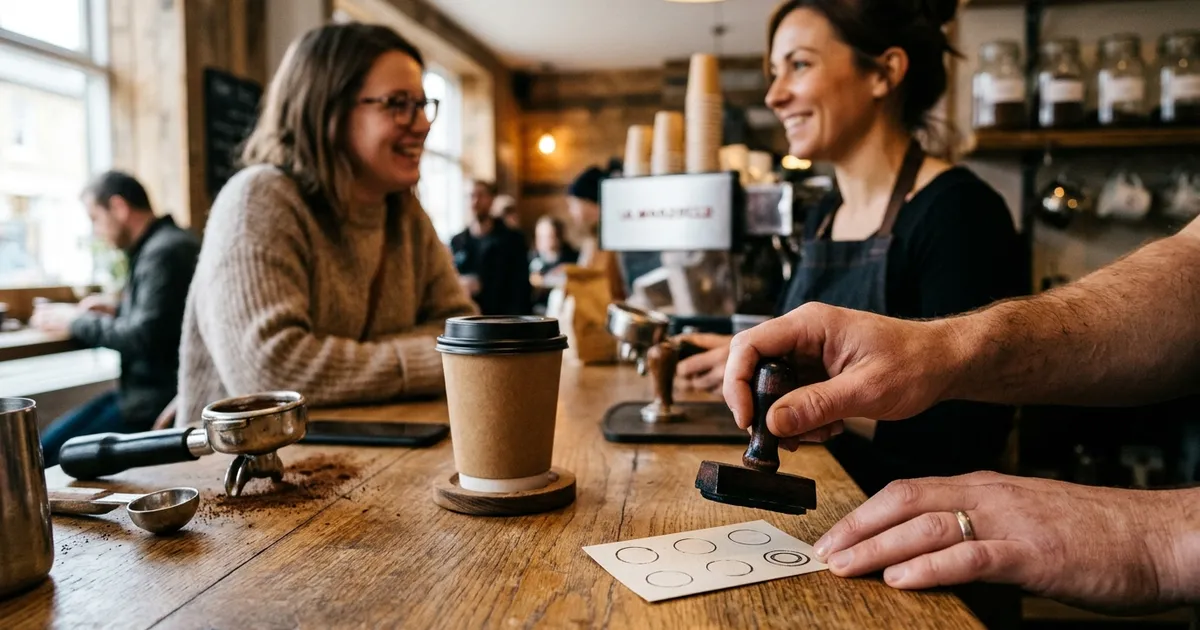
A customer gets the card with their first purchase. Each time they come back and pay, you stamp or initial one box. When every box is filled, they hand the card in and get the reward: a coffee, a haircut, a wash. You keep the full card and give them a fresh one.
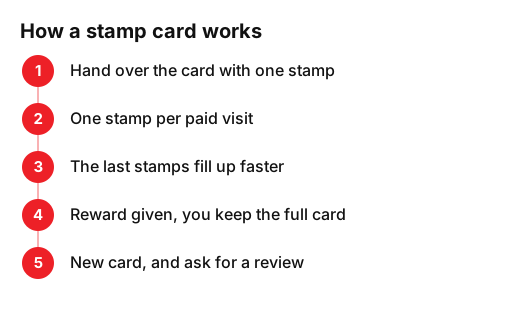
There's a reason this works better than it looks. A 2006 study in the Journal of Marketing Research followed members of a real café's 'buy ten coffees, get one free' scheme and found they bought coffee more often the closer they got to the free one. Put simply, the last few stamps fill up faster than the first.
How many stamps should a loyalty card have?
It depends on how often a typical customer visits. Aim for a card someone can finish in a few months, not a year. If it takes too long, it ends up forgotten in a drawer.
| Business | Typical visits | Stamps | Example reward |
|---|---|---|---|
| Café or bakery | Several a week | 8 to 10 | A free coffee or pastry |
| Barber | Every 3 to 5 weeks | 5 to 6 | Free beard trim, or the 6th cut at half price |
| Nail bar | Every 2 to 4 weeks | 5 to 6 | Free nail art on the next manicure |
| Car wash | Every 1 to 3 weeks | 6 to 8 | A free exterior wash |
These are rough guides. Check how often your own customers really come back and adjust.
One trick from the same study: give stamps away at the start. Customers handed a 12-box card with 2 bonus stamps already on it completed the 10 required purchases faster than customers given a regular 10-box card. They had to buy exactly the same amount; their card just felt started. At your counter, that means stamping the first box on the day you hand the card over.
What reward can you give without losing money?
The reward has to be worth having, or nobody finishes the card. It also has to make sense for you. To check, compare what the reward costs you with what the customer spent to earn it.
Take a café. You sell a coffee for £3.00 and making it (coffee, milk and cup) costs you 60p. Card with 9 stamps and the 10th coffee free:
- The customer pays for 9 coffees: 9 × £3.00 = £27.00.
- The free coffee costs you 60p in stock.
- Reward cost against what they spent: £0.60 ÷ £27.00 = 2.2%.
- If you gave 10% off every coffee instead, you'd hand back £2.70 over the same 9 visits.
With a service the maths changes, because what you give away is time. A barber charging £20 a cut who gives the 6th cut free is handing back 20% of what the customer paid over the previous five (£20 out of £100). And if that free cut lands on a Saturday, it takes a slot you could have sold. Healthier options: a free beard trim, the 6th cut at half price, or a reward that's only valid Monday to Thursday.
To find out what each product or service really costs you, use our profit margin calculator. With that number, choosing the reward takes two minutes.
Paper or digital loyalty card?
For most local businesses, paper is the easiest place to start:
- Paper: you only pay for printing, customers get it straight away and you don't hold anyone's details. Cards get lost more easily, so keep your regulars' cards behind the till.
- Digital: customers can't lose it and you can contact them, but you need their email or mobile number. From that moment you're handling personal data, and the rules further down apply.
If you're just starting out, try paper for three months. If it works and you want to contact customers, look at the next step then.
How do you stop fake stamps?
- Use a stamp with your logo rather than a generic one from a stationery shop. If you don't have one, sign or initial each box.
- One stamp per paid visit. Never in advance, never 'for next time'.
- Number the cards on the back, by hand or with a numbering stamp, and note the number of every card that's redeemed in a notebook.
- When someone claims the reward, keep the card and cross it out in front of them.
- Keep blank cards and the stamp out of customers' reach.
- Make the rule clear to staff: nobody stamps a friend's card without a purchase.
What to print on the card (wording to copy)
The front carries your business name, your logo and the reward in big letters. The small print holds the terms and your website or phone number. You can use this wording as it is:
- Reward: 'Your 10th coffee is on us' or 'On your 6th visit, a free beard trim'.
- Terms: 'One stamp per visit with a purchase. Reward available once the card is full. No cash alternative. One card per person. Valid until [date].'
- Bottom line: your website or phone number, so the card doubles as a reminder.
Adding a valid-until date lets you change the reward later without leaving anyone halfway through a card.
Collecting emails or phone numbers? Follow the rules
A paper card the customer keeps doesn't leave you holding anyone's details. The moment you write down names, phone numbers or emails, data protection applies. In the UK, the government's data protection guidance says personal information must be used fairly, lawfully and transparently, limited to only what is necessary, and handled in a way that ensures appropriate security. In practice: ask only for what you'll actually use, and never leave a sign-up sheet on the counter where the next customer can read everyone's numbers.
Sending offers has its own rule. Regulation 22 of the Privacy and Electronic Communications Regulations bans unsolicited marketing by electronic mail unless the person has consented, and the same regulations define electronic mail as any text, voice, sound or image message, so texts count too. There's an exception for existing customers: if you got their details during a sale, you can market your own similar products and services, as long as you gave them a simple way to refuse when you collected the details and in every message after. If you're unsure about your case, or you trade outside the UK, check with your adviser.
What to do this week
- Choose the reward and run the numbers against your margin.
- Decide how many stamps based on how often customers come back.
- Make the cards and print them on 250 to 300 gsm card.
- Get your stamp ready and explain the rules to staff.
- Hand out every card with the first stamp already on it.
- When someone fills a card, ask for a review with your direct Google review link.
The run-up to Christmas is a good time to start. If you're also selling vouchers this season, here's how to create gift vouchers for your business step by step. If you'd like your cards, vouchers, signs and the rest of your branded printed merchandise to match, we can design them with you. And to get going today, make your stamp cards for free and print them this afternoon.
Frequently asked questions
- What is a customer loyalty card?
- It's a card that rewards people for coming back. In its simplest form, every visit with a purchase earns a stamp, and a full card earns a reward such as a free coffee or service.
- How many stamps should a loyalty card have?
- It depends on how often customers return. 8 to 10 is common for cafés and bakeries, and 5 to 6 for higher-priced services such as barbers, nails or hair. The aim is a card people can finish in a few months.
- What reward should I give without losing money?
- Compare what the reward costs you with what the customer spends to earn it. A free coffee after nine paid ones usually costs very little in stock. For services, give something smaller than the main service or limit the reward to quieter days.
- How do I stop people faking stamps?
- Use a stamp with your logo or sign each box, number the cards, stamp paid visits only and keep the card when the reward is claimed.
- Can I send offers to loyalty card customers?
- In the UK, only with their consent or, for existing customers whose details you got during a sale, about your own similar products and services, always with a simple way to opt out. If in doubt, ask your adviser.
Sources
- Journal of Marketing Research (Kivetz, Urminsky and Zheng, 2006), «The Goal-Gradient Hypothesis Resurrected: Purchase Acceleration, Illusionary Goal Progress, and Customer Retention». home.uchicago.edu/ourminsky/Goal-Gradient_Illusionary_Goal_Progress.pdf
- GOV.UK, «Data protection». www.gov.uk/data-protection
- legislation.gov.uk, «The Privacy and Electronic Communications (EC Directive) Regulations 2003, regulation 22». www.legislation.gov.uk/uksi/2003/2426/regulation/22
- legislation.gov.uk, «The Privacy and Electronic Communications (EC Directive) Regulations 2003, regulation 2». www.legislation.gov.uk/uksi/2003/2426/regulation/2