Estate agent SEO: how local agents win on Google
In this article
- Which searches can a local estate agent actually win?
- How do you improve an estate agent's Google Business Profile?
- How can an estate agent get more Google reviews?
- Area pages: how do you write them without copying yourself?
- Should your listings live on your site or just the portals?
- Which technical basics must not break?
- A 30-day plan to get started
Estate agent SEO has one clear job: when someone nearby searches for an agent on Google, or wants to know what their home is worth, they should find you. Generic searches like “houses for sale in Bristol” tend to be dominated by Rightmove, Zoopla and OnTheMarket, and fighting for them costs a lot for very little. The searches you can win are the local ones, and the ones made by vendors and landlords.
This article is part of our estate agent marketing guide, which covers every channel. Here we focus on Google: your Business Profile, reviews, area pages, your property pages and the technical basics that must not break. If you are planning a new site, also read what an estate agent website needs.
Which searches can a local estate agent actually win?
Think about where your income comes from. You live on instructions, so one vendor or landlord ready to list is worth more than a hundred casual visitors. These are the searches that matter, and the page that should answer each one:
| Search | Who is searching | Page that answers it |
|---|---|---|
| “estate agents in [area]” or “estate agents near me” | Local vendors, landlords and buyers | Your Google Business Profile and home page |
| “how much is my house worth [postcode]” | Homeowners thinking of selling | A valuation page with a short form |
| “living in [area]” or “flats in [area]” | Buyers and tenants moving in | An area page |
| “3 bed house with garden [area]” | Buyers who know exactly what they want | The property page on your own site |
| “[your agency] reviews” | Vendors comparing agents | Your Google profile with recent reviews |
If you only have time for one thing, start with your Google profile and your valuation page. Those two bring in instructions.
How do you improve an estate agent's Google Business Profile?
Google says local results are mainly based on relevance, distance and popularity, and that popularity also depends on how many websites link to your business and how many reviews you have. You cannot change distance. Relevance and popularity are up to you. Check these on your profile:
- Name: your real trading name, exactly as it appears above the door. Adding words like “cheap lettings” or the area name breaks Google's guidelines for representing your business, which warn that your profile could be suspended.
- Primary category: “Estate agent”. Only add secondary categories for work you genuinely do, such as letting or property management.
- Real opening hours, a phone number someone answers and a link to your valuation page, not just your home page.
- Real photos: the shopfront, the window and the team in the office. They help people recognise you when they arrive.
- Posts: a new instruction, a sale agreed or a tip for landlords. One a week is plenty.
For the full checklist, see our guide to checking your Google Business Profile in 7 steps.
How can an estate agent get more Google reviews?
A vendor choosing between two or three agents reads the reviews before booking a valuation. So reviews help you twice: on the Google map and in that final decision. The best moment to ask is when the client is happy: on completion day, when a tenant collects the keys, or when a homeowner tells you the valuation was useful.
A message you can copy into WhatsApp or email:
- “Hi [name], it was a pleasure helping you sell your home in [area]. If you have a minute, would you leave us a review on Google? It really helps other local homeowners choose an agent: [link]”
Create that link with our free tool to make a direct Google review link: the client taps it and the review box opens straight away, with no searching. Reply to every review, including the bad ones, calmly and without personal details. And never offer anything in return: Google Maps content policy bans offering payment, discounts or free services in exchange for a review.
Area pages: how do you write them without copying yourself?
A page for each town, village or postcode district you cover is the best way to show up when someone wants to live there or sell there. The risk is building thirty identical pages with only the place name changed. Google calls that doorway abuse, and one of its examples is having multiple pages targeted at specific regions or cities that funnel users to one page.
A good area page answers what someone moving in, or thinking of selling, would actually ask:
- What the area is like: housing stock (Victorian terraces, new builds, flats), the most sought-after streets and the feel of the place.
- Everyday life: schools, GP surgery, shops, train or bus links and journey times.
- Your current properties for sale and to let in that area, plus the ones you have already sold.
- What you see in your own deals: how quickly homes sell, what buyers ask for, what kind of property is in short supply.
- The person on your team who covers the area, with a photo and direct number.
- A clear button to book a valuation.
Start with three to five areas, the ones that bring you the most instructions. Five useful pages beat forty empty ones. When one is finished, move on to the next.
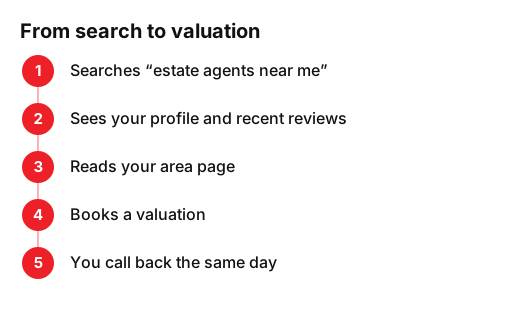
This is how it fits together when a local homeowner looks for an agent:
Should your listings live on your site or just the portals?
Both. The portals bring buyers and there is no reason to leave them. Your own site gives you something a portal cannot: control. Compare:
| Portal listing | Property page on your site | |
|---|---|---|
| Who decides how it looks | The portal | You |
| What appears next to it | Homes from rival agents | Only your properties |
| After the sale completes | The listing disappears | You can mark it “sold” and show your track record in the area |
| Where the enquiry goes | Through the portal | Straight to your office |
To make each property page work on Google, give it its own web address (for example /for-sale/3-bed-terrace-totterdown), a title that states type, bedrooms, sale or let and area, bright photos, a description written for your site rather than pasted from the portal, and an enquiry button that stays visible on a phone.
Which technical basics must not break?
- Mobile speed: property photos are heavy. Compress them before uploading and check that a listing loads quickly on mobile data.
- One address per property and per area, with no duplicates. If a home moves from sale to let, update the same page.
- A different title on every page. If every page is called “[Agency name] Estate Agents”, Google cannot tell which to show for each search.
- RealEstateAgent structured data with your name, address and phone number. You can create it without touching code using our free schema markup generator.
- The same contact details on your site, your Google profile and the portals.
- Search Console set up, so you can see which searches you appear for and which pages have problems.
Not sure how your site is doing right now? Run it through our free website grader and in a minute you will see the most common problems.
A 30-day plan to get started
- Week 1: tidy up your Google profile, add real photos and link your valuation page.
- Week 2: create your review link and send it to clients from your latest completions.
- Week 3: write your first area page, for the area where you sell the most.
- Week 4: fix the titles and photos on your property pages and add structured data.
Real estate SEO takes months to build, so the sooner you start, the better. These four weeks get the foundations in place. If you would rather we handled it, see how we approach SEO for Google and AI search for local businesses.
Frequently asked questions
- What is estate agent SEO?
- It is the work that makes an estate agency show up on Google when someone nearby looks for an agent, wants a valuation or searches for a home in a specific area. It covers your Google Business Profile, reviews, website, area pages and property pages.
- Can a local agent outrank Rightmove or Zoopla?
- For broad searches like houses for sale in a city, it is very hard. Where a local agent can win is searches about its own area, valuation searches and searches that include the agency name, which are the ones that bring vendors and landlords.
- How many area pages should I create?
- Start with three to five, for the areas where you do the most business. Each one needs its own genuine information. Forty identical pages with only the place name changed can work against you.
- Can I offer a reward for Google reviews?
- No. Google Maps content policy bans offering payment, discounts or free services in exchange for reviews. What works is asking at the right moment, with a direct link that opens the review box.
- How long does SEO take for an estate agent?
- Improvements to your Google profile and reviews usually show first. Area pages and property pages take several months. What matters is keeping a steady pace: new reviews every month and a new page once the last one is complete.
Sources
- Google, «Tips to improve your local ranking on Google - Google Business Profile Help». support.google.com/business/answer/7091?hl=en
- Google, «Guidelines for representing your business on Google - Google Business Profile Help». support.google.com/business/answer/3038177?hl=en
- Google, «Prohibited & restricted content - Maps User Generated Content Policy Help». support.google.com/contributionpolicy/answer/7400114?hl=en
- Google Search Central, «Spam Policies for Google Web Search». developers.google.com/search/docs/essentials/spam-policies?hl=en