Estate agent marketing: a guide for local agents

In this article
- What do vendors want, and what do buyers want?
- Estate agent marketing ideas: where to start
- Google Business Profile and reviews
- A website with property pages and a valuation request
- Local SEO: be found in your patch
- Rightmove and Zoopla, or your own website?
- Google Ads for estate agents: is it worth it?
- Social media: what to post without losing hours
- Boards, leaflets and cards: marketing people see in the street
- Referrals and past clients
- If you do lettings, talk to landlords
- Your plan for this week
Estate agent marketing has two jobs for a local agency. The first is winning instructions, so vendors and landlords in your area choose you to sell or let their home. The second is bringing in enquiries from buyers and tenants for the properties you already have. Neglect either and the business struggles: without instructions you have nothing to show, and without enquiries your vendors drift to the agent down the road.
This guide covers the channels that bring vendors and buyers to an independent agency, what to do first and a plan for this week. For the search side in more depth, read our full guide to estate agent SEO.
What do vendors want, and what do buyers want?
Before you pick channels, split your two audiences. They want different things and find you in different places.
| Vendor or landlord | Buyer or tenant | |
|---|---|---|
| What they want to know | Whether you know their street, what their home is worth and how quickly you can sell or let it | Price, photos, floor plan, council tax band and when they can view |
| Where they find you | Google, boards in the street and recommendations from neighbours and friends | Property portals, Google and your website |
| What convinces them | Reviews, homes you have sold nearby and a quick reply | A complete listing and someone who replies the same day |
| What you ask them for | A valuation request or a call | An enquiry or a viewing |
Winning instructions is usually the harder half. Once you have good stock, buyers tend to arrive through the portals. Vendors have to be won, so most of what follows is about getting a homeowner in your patch to trust you before they pick up the phone.
Estate agent marketing ideas: where to start
If you run the agency with a small team, do not try to be everywhere at once. This is the order we recommend, from quick and cheap to the steps that need a budget:
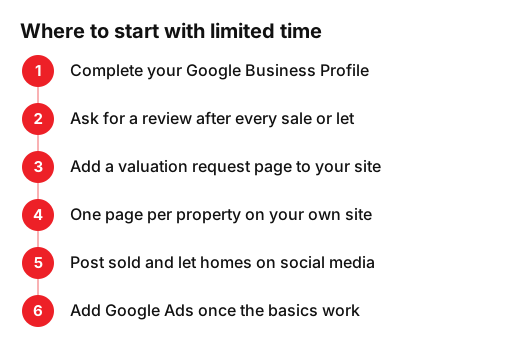
The first five steps only cost you time. Google Ads works far better once you already have reviews and a valuation page to send people to.
Google Business Profile and reviews
When someone searches for ‘estate agents in [your town]’, the first thing they usually see is a map with three agencies. Google's own help says local results are mainly based on relevance, distance, and popularity, and that businesses with complete and accurate information are more likely to show up in local search. You cannot change distance. You can change the rest.
- The right primary category (estate agent) and a description that names the towns, villages or postcodes you cover.
- Real opening hours, a phone number someone answers and a link to your valuation page as well as your homepage.
- Photos of the office, the window and the team. A vendor wants to see who they will be dealing with.
- A post every time you sell or let something, for example: ‘Sold STC on Elm Road in five weeks’.
There is a fuller checklist in 7 things to check on your Google Business Profile.
Reviews carry extra weight in this trade. A vendor is trusting you with what is often their most valuable asset, and they read what other sellers say before they call. Google's help notes that more reviews and positive ratings can help your local ranking, and that positive reviews and helpful replies can help you stand out. The best moment to ask is the day the sale completes or a tenant collects the keys. Create a direct link with our free Google review link generator and send it with a message like this:
‘Hi [name], it was a pleasure helping you sell your home. If you were happy with us, would you leave us a quick Google review? It really helps other people on your street who are thinking of selling. Here is the link: [link]. Thank you!’
Reply to every review, including those from buyers and tenants. Today's happy tenant may be the vendor who rings you in ten years.
A website with property pages and a valuation request
The portals bring buyers, but the listings you put there live on someone else's site. On your own website every property should have its own page: good photos, a floor plan, price, tenure, council tax band, what is nearby and a button to book a viewing. You can share that page on WhatsApp, on social media and through a QR code on the window card.
Those details matter for compliance too. The National Trading Standards Estate and Letting Agency Team's guidance on material information covers details considered material for all properties, including the price, the council tax band and tenure information for sales. GOV.UK is also clear that you must order an EPC for potential buyers and tenants before you market a property to sell or rent. Put this information on your own property pages, not only on the portals.
The most useful page for winning instructions is a valuation request. A homeowner who has not decided to sell will not ring you, but they may leave their details to find out what their home is worth. Ask for as little as possible:
- Street and postcode, or the full address if they are happy to give it.
- Property type and number of bedrooms.
- When they are thinking of moving: now, in a few months or just curious.
- Name and phone number, with a short privacy note.
Then reply fast. If someone requests a valuation on Sunday and you call on Tuesday, they may already have booked two other agents. We cover everything else the site needs in our guide to estate agent website design.
Local SEO: be found in your patch
Local SEO puts you in front of people searching ‘sell my house [area]’ or ‘estate agents near me’. What pays off most: a complete Business Profile, one page for each area or postcode you cover (with typical prices and what you have sold there) and property pages you control. Our SEO guide linked at the start walks through it step by step.
Rightmove and Zoopla, or your own website?
You need both, and each does a different job:
| Property portals | Your own website | |
|---|---|---|
| What they are for | Reaching lots of buyers and tenants who are already looking | Winning vendors and landlords, and reassuring people who already know you |
| Who is in control | The portal decides the layout, the order and which agents appear alongside you | You decide everything and the page stays yours |
| Cost | A regular subscription set by each portal | The website and its upkeep |
| Risk | Buyers compare your property with the agent opposite | If nobody visits, it does nothing: it needs SEO and sharing |
Our advice: list on the portals to sell and let, and use your website for what wins instructions: valuations, area pages, sold properties and reviews.
Google Ads for estate agents: is it worth it?
Google Ads puts you at the top of Google from day one, in exchange for paying per click. For a local agent it makes most sense for winning instructions: searches such as ‘how much is my house worth in [area]’ or ‘sell my house [town]’, sent to your valuation page. For buyers, the portals already do that job.
Keep it local. Google says location targeting helps you focus your advertising on the right customers, and you can target a radius around a location, so you do not pay for clicks from people 30 miles away. If you want to run the numbers first, see how much Google Ads costs in practice.
Social media: what to post without losing hours
Social media rarely brings a buyer overnight, but a homeowner who has followed you for months will call you before a stranger. Post a little, and often:
- New instructions with a short video walking through the home.
- Sold STC and let agreed updates, with how long it took.
- The local area: the independent bakery, a park, a school, the new station entrance.
- Your team, with names and faces. People want to know who will show them round.
Two or three good posts a week are enough. Each one should lead somewhere: the property page or your valuation page.
Boards, leaflets and cards: marketing people see in the street
For a local agent, print still earns its place because the next vendor lives two streets away. Ideas you can use now:
- For Sale and To Let boards with your number in large type and a QR code to the property page, always with the owner's agreement. Check your council's rules, as some areas restrict boards.
- Just sold leaflets in the streets around a sale, with wording such as: ‘We have just sold a home on your street. Thinking of selling? We will tell you what yours is worth, with no obligation.’ Skip doors with a no junk mail sign.
- A tidy, up-to-date window with fewer properties shown well and the EPC rating on each card.
- Business cards with a QR code to your valuation page.
We will soon publish more detailed guides on winning more instructions, property photography, estate agent leaflets and boards, and advertising.
Referrals and past clients
Plenty of instructions come from someone who already knows you: last year's vendor, a tenant, a local conveyancer or a mortgage broker. Look after them:
- Get in touch with past clients once a year, for example on the anniversary of their move.
- When each sale or let completes, ask: ‘Do you know anyone thinking of selling or letting?’
If you do lettings, talk to landlords
Landlords choose an agent on different things from vendors: how you vet tenants, how quickly you usually let, how you handle repairs and late rent. Put that on a landlord page on your website, with reviews from landlords, and send it with every rental valuation.
Your plan for this week
- Monday: check your Google Business Profile (category, hours, photos and a link to your valuation page).
- Tuesday: send the review message to your last five happy clients.
- Wednesday: build your valuation page with four fields and a promise to reply within 24 hours.
- Thursday: check that every listing, on your site and on the portals, shows the EPC, price, council tax band and tenure.
- Friday: post your latest sale or let on social media and leaflet that street.
If you would rather we set it up with you, see how we help property businesses or get in touch and we will talk it through.
Frequently asked questions
- What is estate agent marketing?
- Estate agent marketing, often called real estate marketing, is everything an agency does to get vendors and landlords in its area to instruct it, and to get buyers and tenants to enquire about its properties: Google Business Profile, reviews, its own website, the portals, ads, social media and printed material.
- What are good estate agent marketing ideas on a tight budget?
- Start with the free basics: a complete Google Business Profile, a review request after every sale or let, a valuation request page on your website, one page per property and just sold leaflets in the streets where you have sold. Add Google Ads later.
- Is listing on Rightmove and Zoopla enough?
- The portals are good for finding buyers and tenants, but they do little to win instructions and buyers see other agents' properties right next to yours. Combine them with your own website, your Google Business Profile and reviews.
- What must a property listing include?
- National Trading Standards guidance on material information covers the price, the council tax band and, for sales, tenure for every property, and GOV.UK says you must order an EPC before marketing a property to sell or rent. Check the latest National Trading Standards guidance before you publish.
- Is Google Ads worth it for estate agents?
- It is usually worth it for winning instructions, with ads for searches such as how much is my house worth, limited to your area and sent to a valuation page. Start once you already have reviews and a website that replies quickly.
Sources
- Google (Business Profile Help), «Tips to improve your local ranking on Google». support.google.com/business/answer/7091?hl=en
- National Trading Standards, «National Trading Standards publishes guidance on Part A material information for property listings». www.nationaltradingstandards.uk/news/national-trading-standards-publishes-guidance-on-part-a-material-information-for-property-listings
- GOV.UK, «Selling a home: Energy Performance Certificates». www.gov.uk/buy-sell-your-home/energy-performance-certificates
- Google (Google Ads Help), «Target ads to geographic locations». support.google.com/google-ads/answer/1722043?hl=en